
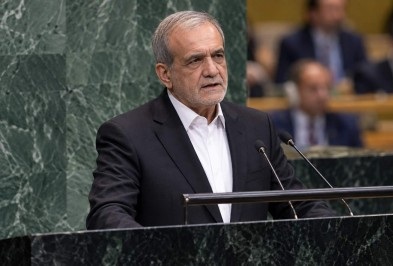
The ongoing tensions between the United States and Iran could have significant implications for global shipping and energy markets, particularly if the Strait of Hormuz remains a focal point of conflict. Iranian President Masoud Pezeshkian, addressing the United Nations General Assembly, emphasized that Iran is open to diplomacy but firmly opposes negotiations conducted under threats or military pressure.
Pezeshkian’s remarks came on the heels of U.S. President Donald Trump’s speech at the UN, where he mentioned potential further actions against Iran while also leaving the door open for renewed discussions. This diplomatic back-and-forth underscores the fragile nature of U.S.-Iran relations, with both countries showing a willingness to engage in talks, albeit under heavily stipulated conditions.
During the assembly, a significant meeting took place between Iranian Foreign Minister Abbas Araghchi and U.S. special envoy Steve Witkoff. Held through Qatari mediation, the three-hour discussion focused on Iran’s stipulations for resolving the ongoing conflict and alleviating pressure on the nation. A major point of contention remains the Strait of Hormuz, a critical waterway for international shipping that Iran has threatened to close if its conditions are not met.
Among Iran’s demands are the cessation of hostilities, lifting of the naval blockade, and economic sanctions, as well as the release of Iranian assets. Pezeshkian reiterated that Iran seeks a peaceful nuclear program and does not aspire to develop nuclear weapons. He also called for regional collaboration on security issues, advocating for a move away from reliance on external powers.
The diplomatic engagement at the UN indicates that despite severe disagreements over sanctions, nuclear ambitions, and regional security, both Washington and Tehran are still considering dialogue as a pathway forward. However, the complexity of their demands and the strategic importance of the Strait of Hormuz mean that any negotiations will require careful navigation to avoid impacting global markets further.
Pezeshkian also accused the United States and Israel of aggressive actions towards Iran, defending Tehran’s stance as one of self-defense. As economic pressures continue to mount due to sanctions, Iran’s ability to export oil remains a critical issue, highlighting the broader economic consequences tied to the geopolitical tensions in the region.