
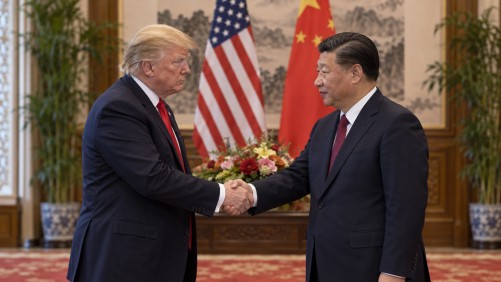
The upcoming meeting between U.S. President Donald Trump and Chinese President Xi Jinping could significantly impact global trade and technology relations, even if immediate breakthroughs are not expected. Set to take place in the United States, this meeting underscores ongoing tensions over trade agreements, technology restrictions, and geopolitical issues like Taiwan, with potential global ramifications.
Central to the discussions will be artificial intelligence, a field where both nations are vying for supremacy. The U.S. has proposed establishing a communication mechanism with China to ensure AI safety and governance. However, differing perspectives on the development and risks associated with AI persist, especially since the U.S. has restricted China’s access to advanced semiconductors crucial for AI development. China, on the other hand, views these restrictions as attempts to stifle its technological advancement.
Trade relations are also on the agenda, with the expiration of a temporary U.S.-China trade agreement looming in November. While Beijing seeks long-term stability, Washington considers trade measures as leverage. The existing agreement includes tariff measures and restrictions on Chinese rare-earth exports, and its potential expiration could disrupt trade dynamics.
Taiwan remains a contentious issue, particularly with the U.S.’s defense ties to the island, which China claims as its territory. Future U.S. arms sales to Taiwan are likely to be a sensitive topic during the discussions, reflecting broader geopolitical tensions between the two nations.
Beyond bilateral issues, broader international concerns such as the conflicts involving Iran and Ukraine are expected to be part of the dialogue. China’s economic ties with Iran and its relationship with Russia are pivotal in these discussions, highlighting the complex web of global alliances and rivalries.
As the two superpowers navigate their strategic rivalry, the meeting is a critical step in maintaining channels of communication on issues that bear on global trade, technology, and security. While the immediate outcomes might be limited, the long-term implications of these discussions could shape future U.S.-China relations and their influence on the world stage.